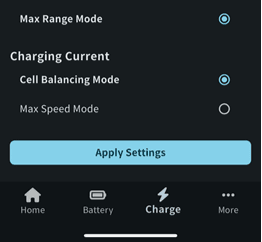
⚙️ Charging Settings
🔋 Charging Limit
Limits the maximum SOC (State of Charge) based on charging mode to optimize battery lifespan.
✅ Role of Charging Limit:
Battery Protection: Prevents prolonged storage at high SOC to reduce degradation and extend lifespan.
Optimized Charging Strategy: Adjusts charging behavior for normal use, long-distance driving, and battery protection.
🚗 Setting an appropriate charging limit helps maximize battery life. 🔋
⚡ Charging Current
Cell balancing mode automatically adjusts the charging current to optimize cell balancing.
✅ Role of Charging Current Adjustment:
Maintains voltage balance between cells.
Protects battery performance and longevity.
🚗 Use cell balancing mode to optimize battery condition! 🔋
🔍 Charging Monitoring
🔄 Charging Status
Charging status is categorized into the following states:
✅ Charging Status Definitions:
Disconnected: The charger is unplugged.
Charging Start: Charging process has begun.
Charging: Charging is in progress.
Charging Stopped: Charging has been interrupted for various reasons. (⚠️ Possible charger compatibility or adapter issues.)
No Power: The charger is connected but not supplying power. (⚠️ Potential charger or adapter malfunction.)
Charging Complete: Charging has finished normally.
⚠️ If "Charging Stopped" or "No Power" occurs frequently, check the charger or adapter for issues. 🔌🔋
🔋 Charging Limit Monitoring
Displays the maximum SOC (State of Charge) that can be charged based on the current battery level.
✅ Charging Limit & Battery Lifespan:
Charging to 100% is not recommended → Accelerates long-term degradation.
NCA & NCM batteries are especially susceptible to lifespan reduction when charged to high SOC at high temperatures.
🚗 Set an appropriate charging limit to protect battery health. 🔋
⚡ Charging Current Monitoring
Displays both the maximum possible charging current and the current charging current.
✅ Charging Current Information:
Maximum Charging Current: The highest current the battery and charger allow.
Current Charging Current: The actual current being used for charging.
🚗 Monitor charging speed and check for fluctuations to ensure stable charging. 🔋⚡
⚡ Charging Voltage Monitoring
Displays the real-time charging voltage of the charger.
✅ Charging Voltage Information:
Allows real-time monitoring of the charger’s output voltage.
Useful for diagnosing battery and charger conditions.
🚗 Monitor charging voltage for stable and efficient charging. 🔋⚡
📊 Charging Efficiency
Measures the ratio of charging energy to the actual energy stored in the battery.
Charging efficiency varies depending on vehicle condition and charging environment.
✅ Low Charging Efficiency May Indicate:
If the vehicle is not consuming energy but efficiency is low, actual stored energy is less than expected.
If charging efficiency is low while current is high, excessive heat may be generated at the adapter or connector, potentially affecting charging safety.
🚗 Monitor charging efficiency regularly to maintain safe and cost-effective charging. 🔋⚡
📊 Recent Charging Efficiency
Displays the average charging efficiency at the end of a charging session.
✅ Charging Efficiency Insights:
Shows the proportion of energy that was successfully stored in the battery.
Data discrepancies may occur depending on vehicle configuration.
🚗 Monitor charging efficiency to optimize battery charging performance. 🔋⚡
🔌 Pack Current Monitoring
Displays the actual current entering the battery pack during charging.
✅ Pack Current Insights:
Allows real-time monitoring of the current being supplied to the battery.
Useful for diagnosing charging stability and battery condition.
🚗 Monitor pack current for efficient and stable charging. 🔋⚡
🔋 Pack Voltage Monitoring
Displays the real-time voltage of the battery pack.
✅ Pack Voltage Insights:
Helps assess the charging status and overall battery condition.
Voltage fluctuations may occur during charging/discharging and can vary based on environmental conditions.
🚗 Regularly check battery voltage to maintain optimal performance. 🔋⚡
⚠️ Charging Abnormality Detection
🛑 Overcurrent Detection
Occurs when the battery management system (BMS) detects a charging current higher than expected.
✅ Overcurrent Warning & Risks:
Can lead to faster battery degradation and safety risks.
Sustained overcurrent may increase heat generation and damage the battery.
⚠️ If overcurrent is detected frequently, an inspection is recommended. 🚗🔋⚡
⚠️ Undercurrent Detection
Occurs when the BMS detects a charging current lower than expected.
✅ Undercurrent Warning & Possible Causes:
May indicate reduced charging speed due to vehicle or charger conditions.
Could be influenced by battery protection measures or external factors.
🚗 If undercurrent is detected frequently, check the charging system for potential issues. 🔋⚡
⚠️ Overcharging Detection
Detects when charging exceeds the preset maximum SOC.
✅ Risks Associated with Overcharging:
Battery lifespan reduction: Consistently overcharging accelerates degradation.
Safety concerns: Increased internal pressure and heat buildup can pose risks.
⚠️ If overcharging occurs repeatedly, adjust charging settings immediately. 🚗🔋⚡
🚗 Dr.EV provides comprehensive charging settings, monitoring, and optimization tools to enhance battery health and safety.📌 Use Dr.EV to manage charging efficiency, prevent overheating, and maximize battery lifespan! 🚀🔋
🔋 Actual Battery Level Monitoring
SOC (State of Charge) is estimated by the BMS (Battery Management System) and may vary in accuracy depending on the manufacturer’s technology.
At 25°C, the typical SOC estimation error is within ±3%, but accuracy may differ among manufacturers.
✅ SOC Error & Battery Safety Margins:
Manufacturers set SOC safety margins to compensate for SOC estimation errors.
If SOC errors are large and safety margins are too small, the battery may frequently experience overcharging or deep discharging, leading to accelerated degradation and safety risks.
✅ BMS Calculates Two Types of SOC Values:
1️⃣ Usable SOC:
Adjusted for current operating conditions (temperature, charging/discharging rate, etc.).
Displayed to the driver and used for estimating driving range.
2️⃣ Actual Battery Level (Actual SOC):
Based purely on total battery capacity without adjusting for external conditions.
Used internally by the BMS for system calculations and diagnostics.
⚠️ Extreme temperatures or fast charging/discharging can create discrepancies between displayed and actual SOC values.
In very hot or cold conditions, the displayed SOC may be different from the actual battery capacity.
🚨 To prevent battery degradation and ensure safety, avoid allowing the actual battery level to reach 0% or 100% frequently.→ Regular charging within the recommended SOC range helps extend battery lifespan. 🔋🚗
🔋 Remaining Energy Monitoring
Displays the amount of energy available until the next charge is required.
✅ Factors That Affect Remaining Energy:
Driving Conditions: Speed, road surface, and driving style influence energy consumption.
Temperature Changes: Extreme cold or heat can reduce usable energy.
Charging/Discharging Speed: Sudden acceleration or deceleration may cause temporary fluctuations.
🚗 Monitor remaining energy regularly to plan efficient driving routes. 🔋
🌡️ Charging Temperature Monitoring
Displays the actual battery pack temperature while charging.
✅ Battery Temperature & Thermal Management:
If the battery temperature stays around 25°C with minimal fluctuations, thermal management is working effectively.
If temperature differences are large or abnormally high, the thermal management system may need inspection.
⚠️ High battery temperatures can cause charging speed limitations and long-term battery degradation. 🚗🔋🔥
⚡ Charging C-Rate Monitoring
Measures how aggressively the battery is being charged.
✅ C-Rate Calculation Example:
A 100Ah battery charged at 100A = 1C-rate.
LFP batteries are more sensitive to high C-rates and may experience lifespan reduction.
🚗 Adjust charging speed based on battery type to maximize longevity. 🔋⚡
⏳ Estimated Charging Time
Displays the estimated time to reach the user-defined maximum charging limit.
✅ General Charging Characteristics:
SOC 20%–80% Range: Constant Power or Constant Current charging phase, allowing the highest charging speed.
Extreme Temperatures: Charging speed may be automatically limited to protect the battery.
⚠️ Charging time can vary depending on charger output, battery status, and environmental conditions.🚗 Plan charging sessions efficiently to minimize waiting times. 🔋⚡