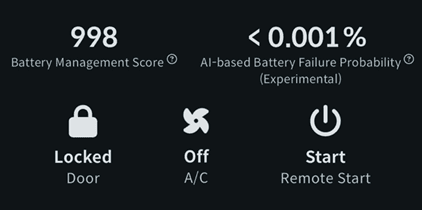
🔋 Battery Management Score
Evaluates driving and charging habits, battery condition, and external environmental factors in real-time.
✅ Score Meaning:
Higher scores → Indicates proper battery management.
Lower scores → May negatively impact battery performance and lifespan, requiring improvements in driving and charging habits.
🚗 Regularly check your battery score to optimize battery lifespan! 🔋📊
🛑 AI-Based Battery Failure Probability
Uses AI analysis to predict potential battery issues, including Thermal Runaway.
✅ Currently in Experimental Phase:
This feature is under active development, with ongoing improvements.
The model is being trained and tested across various driving environments to enhance accuracy.
⚠️ Since this feature is experimental, please use it for reference only. 🚗🔋
📏 Total Driving Distance
Displays the total distance the vehicle has traveled so far.
✅ Relationship Between Driving Distance & Energy Consumption:
Driving habits affect the total distance traveled per kWh of energy used.
Battery lifespan gradually decreases based on total energy consumption, with up to a 2x difference depending on management practices.
⚠️ Battery Degradation & Safety Considerations:
EV batteries are designed to limit usage once they reach a critical degradation point (Knee Point) to prevent drastic performance loss.
As battery degradation progresses, the risk of Thermal Runaway may increase, making proper battery management essential. 🚗🔋
🌡️ Temperature Monitoring
Interior Temperature: Displays the cabin temperature. 🚗🌡️
Exterior Temperature: Displays the outside temperature. 🌍🌡️🚗
Battery Temperature Status: Categorized into Normal, Warm, Cold, Frozen, and Severely Frozen.
✅ Impact of Battery Temperature:
LFP (Lithium Iron Phosphate) Batteries: Performance and lifespan may degrade when exposed to cold temperatures.
NCA (Nickel Cobalt Aluminum) / NCM (Nickel Cobalt Manganese) Batteries: High temperatures can negatively impact performance and lifespan.
⚠️ Extreme temperatures may lead to performance loss and accelerated degradation, making temperature regulation crucial. 🚗🔋
🔋 Battery Type
EV batteries come in three types: NCA, NCM, and LFP, each with distinct characteristics.
✅ Comparison of Battery Types:
NCA: High energy density and lightweight but has lower safety and lifespan.
NCM: Balanced performance, widely used in EVs, offering a good mix of efficiency and durability.
LFP: High safety and long lifespan but has lower energy density, resulting in increased weight and size.
📉 Fast SOH (State of Health) Estimation
SOH indicates the remaining battery capacity compared to its original capacity and is a key metric for assessing battery health.
✅ SOH Variations in Early Battery Usage:
Capacity Increase: Initially inactive lithium ions may become active, temporarily increasing capacity.
Capacity Decrease: Formation of the SEI (Solid Electrolyte Interphase) layer can reduce available lithium ions, causing an initial capacity drop.
✅ SOH & Battery Usage Limits:
EV batteries generally limit usage when SOH falls to 60-70% to prevent rapid degradation.
Fast SOH is calculated quickly under specific conditions and may differ from the SOH displayed on the battery screen.
📌 To check a more accurate SOH value:
Review the SOH reading on the battery screen.
Monitor battery health using the Battery Score.
🚗 SOH is a key battery health metric, requiring regular monitoring. 🔋
⚡ C-Rate (Charging/Discharging Speed)
C-Rate measures how aggressively the battery is charged or discharged.
✅ C-Rate Calculation Example:
100Ah battery charged at 100A = 1C-rate.
Positive (+) values indicate charging, while negative (-) values indicate discharging.
✅ C-Rate Impact by Battery Type:
LFP Batteries: High C-rates can shorten lifespan due to lower high-power handling capability.
NCM Batteries: Sustained high C-rate charging at high temperatures can accelerate degradation and increase the risk of Thermal Runaway.
🚗 Maintaining an optimal C-rate helps protect battery longevity! 🔋⚡
⚡ Pack Insulation Status
Monitors insulation resistance to prevent electric leakage and safety hazards.
✅ Five Levels of Insulation Status:
Good: High insulation, normal condition.
Moderate: Standard insulation level.
Poor: Slightly reduced insulation resistance but still within the normal range.
Warning: Low insulation resistance—requires attention.
Critical: Insulation is almost completely compromised—immediate inspection and repair required.
⚠️ If "Critical" status is detected, immediate inspection is necessary to prevent electric shocks or safety hazards. 🚗⚡
⚖️ Cell Balancing Status
EV battery packs consist of multiple battery cells, which may develop energy imbalances due to differences in manufacturing tolerances, thermal management, or usage conditions.
✅ Why Cell Balancing Matters:
If cells become highly imbalanced, the weakest cell (lowest voltage) will determine the battery pack’s total usable capacity, reducing driving range.
BMS (Battery Management System) stops discharging based on the lowest cell voltage and stops charging based on the highest cell voltage, meaning severe imbalances reduce total performance.
✅ Types of Cell Balancing:
Passive Balancing:
Uses resistors to burn excess energy and equalize cell voltage.
Usually only occurs during charging.
Less efficient and takes longer.
Active Balancing:
Transfers energy from higher-voltage cells to lower-voltage cells.
Some manufacturers enable balancing during driving.
More efficient but requires complex circuitry, making it uncommon in production EVs.
✅ Dr.EV’s Optimized Cell Balancing Method:
Most EV BMS systems perform cell balancing automatically with no user control.
Dr.EV minimizes charging current to maximize balancing effectiveness.
If cell balancing is labeled as "Poor," using Dr.EV’s "Cell Balancing Mode" is recommended.
Severely imbalanced cells require multiple balance-charging sessions to gradually restore equilibrium.
⚠️ Unresolved cell imbalances can reduce battery range and performance.
If balancing remains poor while the vehicle is idle (not charging or discharging), it indicates a significant imbalance.
🚗 Regularly check and use Dr.EV’s balancing mode to optimize battery health. 🔋
🔋 Actual Battery Level Monitoring
SOC (State of Charge) is estimated by the BMS (Battery Management System) and may vary in accuracy depending on the manufacturer’s technology.
At 25°C, the typical SOC estimation error is within ±3%, but accuracy may differ among manufacturers.
✅ SOC Error & Battery Safety Margins:
Manufacturers set SOC safety margins to compensate for SOC estimation errors.
If SOC errors are large and safety margins are too small, the battery may frequently experience overcharging or deep discharging, leading to accelerated degradation and safety risks.
✅ BMS Calculates Two Types of SOC Values:1️⃣ Usable SOC:
Adjusted for current operating conditions (temperature, charging/discharging rate, etc.).
Displayed to the driver and used for estimating driving range.
2️⃣ Actual Battery Level (Actual SOC):
Based purely on total battery capacity without adjusting for external conditions.
Used internally by the BMS for system calculations and diagnostics.
⚠️ Extreme temperatures or fast charging/discharging can create discrepancies between displayed and actual SOC values.
In very hot or cold conditions, the displayed SOC may be different from the actual battery capacity.
🚨 To prevent battery degradation and ensure safety, avoid allowing the actual battery level to reach 0% or 100% frequently.→ Regular charging within the recommended SOC range helps extend battery lifespan. 🔋🚗
🔋 Remaining Energy Monitoring
Displays the amount of energy available until the next charge is required.
✅ Factors That Affect Remaining Energy:
Driving Conditions: Speed, road surface, and driving style influence energy consumption.
Temperature Changes: Extreme cold or heat can reduce usable energy.
Charging/Discharging Speed: Sudden acceleration or deceleration may cause temporary fluctuations.
🚗 Monitor remaining energy regularly to plan efficient driving routes. 🔋
🔄 Cumulative Cycle Count
Displays the number of charge/discharge cycles completed.
Calculated based on total energy used, divided by battery capacity, rather than simple charge/discharge counts.
✅ Battery Lifespan & Cycle Count:
EV battery packs are designed for 1,000 to 2,000 cycles, excluding aging-related degradation.
Elon Musk has stated that Tesla batteries are designed to last approximately 1,500 cycles.
⚠️ Battery lifespan is influenced by factors beyond cycle count, including:
Environmental conditions (temperature, humidity, etc.).
Charging speed (frequent fast charging accelerates degradation).
SOC management (maintaining optimal charge levels).
🚗 To extend battery lifespan, adopt proper charging and discharging habits. 🔋
📊 Cumulative Driving Efficiency (km/kWh)
Measures overall energy efficiency, with higher km/kWh values indicating better energy usage.
For example, the Tesla Model 3 RWD has a rated combined efficiency of 5.7 km/kWh.
✅ Factors That Affect Driving Efficiency:
Driving style: Avoiding rapid acceleration and braking improves efficiency.
Non-driving energy consumption: Using climate control, infotainment, or standby power reduces efficiency.
📌 Want to check only driving efficiency?
Go to the Battery screen to view driving efficiency separately.
Compare efficiency with other vehicles using Dr.EV’s weekly statistics. 🚗🔋
📊 Cumulative Driving Efficiency (Wh/km)
Displays energy efficiency in terms of energy consumed per km driven (Wh/km).
✅ Factors That Affect Driving Efficiency:
Driving style: Smooth driving improves efficiency.
Non-driving energy consumption: Climate control and other vehicle functions can reduce overall efficiency.
🚗 Improve energy efficiency by adopting efficient driving habits!
📌 Want to check only driving efficiency?
Go to the Battery screen to view driving efficiency separately.
Compare with other vehicles using Dr.EV’s weekly statistics. 🚗🔋