BatterMachine, August 2026.
Battery faults usually appear while the battery is working hard: during fast charging, hard acceleration, or hard braking. This one appeared while the car was parked. Among the recent failure cases we have analyzed, it is the first that started this way.
To be clear from the start: battery failures that begin while a car is parked are very rare, and nothing in this case overheated. The pack stayed at 30.5 °C before, during, and after the event. On the evidence below, the cells themselves look healthy. The problem appears to be in a connection or sensing path inside the pack, not in the cells.
What happened
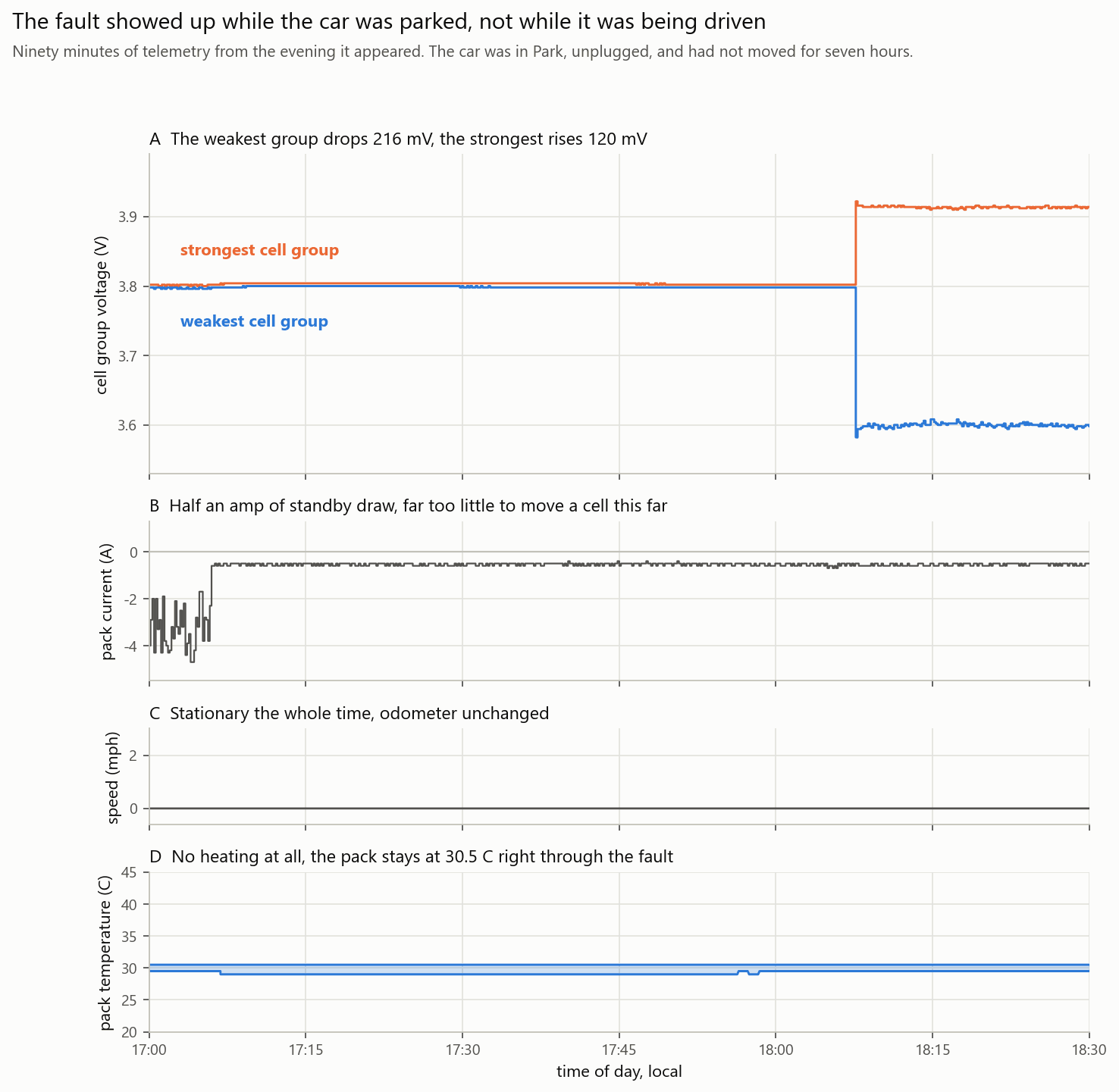
The vehicle is a 2020 Model 3 Long Range with about 125,000 km and roughly 400 full charge cycles. It had been parked for almost seven hours, unplugged, with a discharge current of about 0.5 A, as the figure below shows. Then the two cell group voltages that the car reports, the highest group and the lowest group, suddenly separated. The lowest reading dropped by 216 mV and the highest reading rose by 120 mV at the same time. The difference between the two readings jumped from 4 mV, where it had stayed for the previous ten months, to 340 mV, and it has remained that wide ever since.

Throughout this period the car was in Park, the speed was zero, the odometer did not move, the charge port was disconnected, and the temperature was constant.
Why this does not look like a cell problem
When a cell group loses charge, its voltage falls. No other group's voltage rises in response. Here, one reading rose at the same moment the other fell. Charge also cannot move from one group to another: the groups are connected in series, so the same current flows through all of them.
The size of the drop does not fit a real discharge either. A 216 mV drop corresponds to losing about 20% of the group's charge. To lose that much charge in under twenty minutes, a current of about 110 A would have to flow. The figure above shows the actual current: about 0.5 A. And if that charge had instead been consumed inside the pack through an internal short, its energy would have been released as heat, roughly 400 W concentrated in one spot for eighteen minutes. The module temperature never moved from 30.5 °C.
There was also no warning. A cell group with a real internal problem degrades over weeks or months, so the voltage difference would have widened gradually before the failure. It did not. The difference stayed flat for ten months and then jumped in a single sample.
What it looks like instead

Each cell group's voltage is measured between two sensing points, and two neighbouring groups share the point between them. That shared point is added to one group's measurement and subtracted from its neighbour's. So if the voltage at that one point is wrong, one group reads too high and its neighbour reads too low, which is exactly the pattern seen here, from a single cause.
For this reason, the most likely explanation is that a connection or sensing path between two adjacent groups has partially broken, rather than that a cell has failed. One caveat: in a pack where single cells are connected in series, instead of parallel groups, a genuine cell failure can produce a similar pattern.
After this event, the owner reported a BMS_a079 alert during charging. The exact cause can only be confirmed by opening the pack, but the data points away from the cells and toward the connections around them.