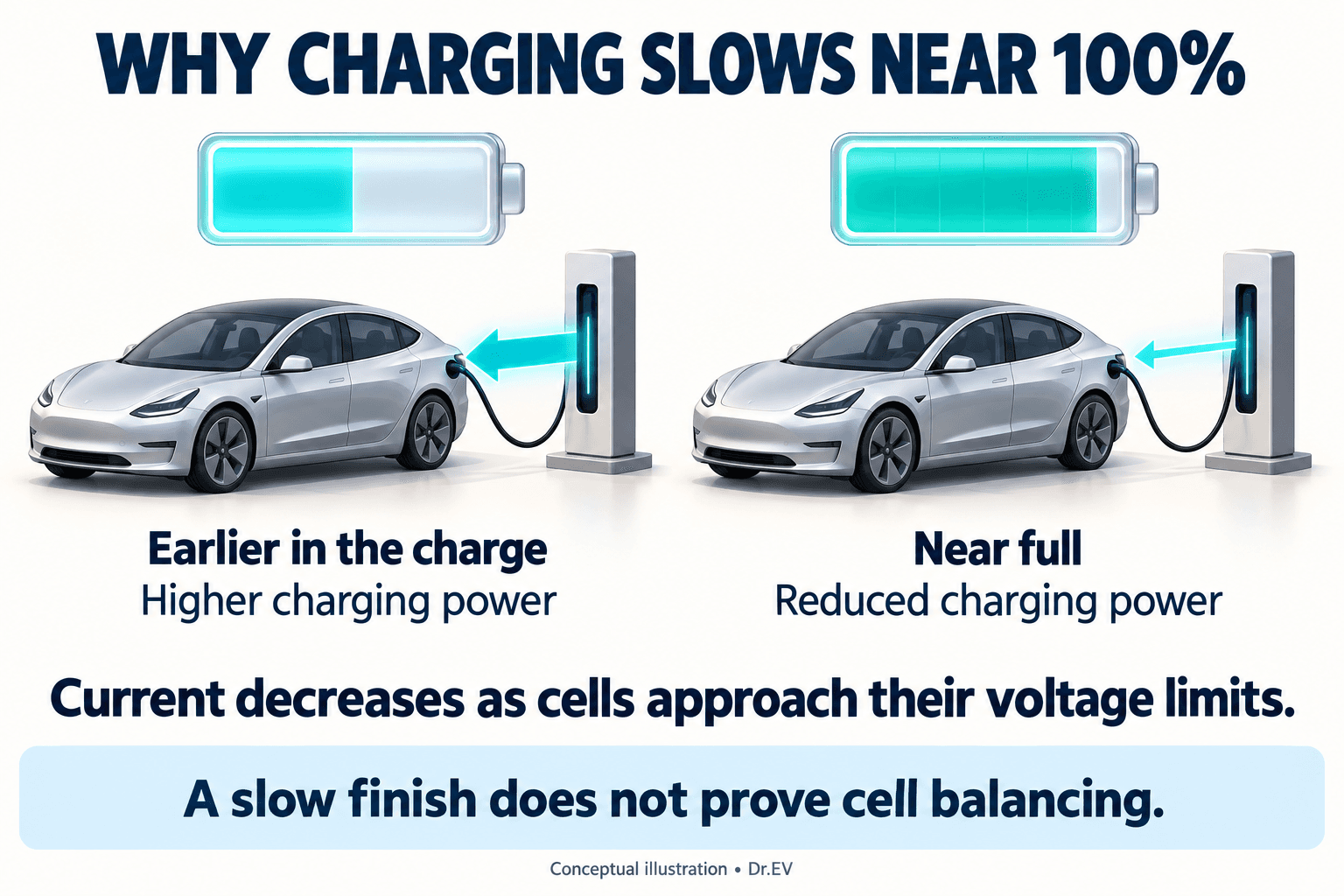
Charging a Tesla from 90% to 100% can feel surprisingly slow. That long wait sometimes leads to a mistaken conclusion: the Supercharger must be balancing the battery, and Supercharging must be necessary to do it.
Cell balancing is managed inside the vehicle’s battery system. The charger’s power rating does not determine how quickly passive balancing works. Under suitable conditions, slower AC charging can give the battery more time to balance.
The first distinction is between charging taper and cell balancing.
As a lithium-ion battery approaches its upper voltage limits, charging current decreases. This taper helps the battery finish charging within those limits, even when the cells are already well balanced. Tesla confirms that charging slows as the battery fills and that reaching 100% typically takes significantly longer than reaching 80%. A long final stretch, by itself, tells you nothing definite about balancing activity. Tesla’s Supercharging guidance, Analog Devices’ explanation of lithium-ion charging.

Charging slows as cells approach their voltage limits. A slow finish alone does not prove that balancing is active.
Passive balancing performs a different job. Cells or cell groups connected in series can develop differences in their state of charge. One group may reach its upper limit while others still have room to accept charge.
A passive balancing circuit uses a small current through a resistor to remove charge from selected groups, dissipating that energy as heat. During charging, this reduces the net current entering those groups, allowing the others to catch up. The battery management system, or BMS, decides when the circuit operates. Analog Devices: Passive Battery Cell Balancing.
Connecting a more powerful charger does not make that small balancing current proportionally larger. The amount of charge the circuit can remove depends on its balancing current and the accumulated time it is actually operating.
This is where slow charging can help.
A lower charging current can extend the time the battery spends in conditions where its BMS permits balancing. That gives the small balancing circuit more opportunity to reduce differences between groups before charging finishes. Texas Instruments identifies quick charging as a situation with limited balancing opportunity and explains that balancing commonly takes place during charging or idle periods. This is a general engineering principle; the actual operating conditions depend on the vehicle’s battery and control software. Texas Instruments’ balancing design guide, Section 4.2.6.3.
The benefit is additional operating time. Slower charging does not make the balancing circuit itself faster, and simply leaving a car plugged in does not establish that balancing is active throughout that period.

Passive balancing uses a small bypass current around selected higher-charge groups. Slower charging can provide more time for this process when the vehicle’s BMS permits it.
Dr.EV provides a separate Cell Balancing Mode to make a lower-current charging setting easier to select. Its purpose is to support conditions in which the vehicle’s own BMS has more opportunity to balance. The charge limit remains a separate choice, and the vehicle retains control of the internal balancing process.
There is no need to turn balancing into a routine of holding every Tesla at 100%. Follow the charging recommendations shown for your particular vehicle. Tesla advises avoiding extended periods near full charge and directs owners to the vehicle’s recommended daily and trip limits. Tesla’s battery-care guidance.
Balancing can address differences in charge between cell groups; it cannot reverse chemical aging or repair a defective cell. Its value comes from helping the battery use the capacity it still has.
A Supercharger helps you add energy quickly on a journey. When you have time for a slower AC charge, Dr.EV’s Cell Balancing Mode offers a convenient way to select a charging current intended to support balancing.